
One of the lawyers of the chief minister said that they will be seeking urgent listing of the petition on Monday.

'Unlike in the sporting arena, where sports federations moved from partisan to impartial referees, in Indian democracy's biggest festival, it appears we are moving backward from unbiased and objective to one-sided and partisan,' observes Nilanjan Mukhopadhyay.

This was the near-unanimous replies of 10 market participants.

Jaismine Lamboria registered a dominant victory over Ana Marija Milisic of Switzerland to enter the 57kg quarter-finals of the World Olympic Boxing Qualifier in Bangkok.

'With China falling out of favour, India is where investors see the demographic and digital dividend apart from the benefits of reforms playing out.' 'Your prime minister has also done a great job of sharing this story with the world.'

The high court of Jharkhand on Friday granted bail to former chief minister Hemant Soren in a money laundering case linked to a land scam.

Equity market sentiment this week will be guided by global trends in the absence of any major domestic triggers, while bourses may also see some volatility amid expiry of derivatives contracts, analysts said. Fears of sooner-than-expected tapering in monetary stimulus by the US Federal Reserve, rising cases of the Delta variant of the coronavirus coupled with China's regulatory crackdown triggered selling in global markets in the previous week.

Wall Street-correlated stock markets are facing the risk of correction, as Christopher Wood, the global head of equity strategy at Jefferies, conveys to investors in his latest edition of GREED & fear. Rising crude oil prices, which are nearing $100 a barrel (Brent), pose a threat to the global central bank's battle against inflation and have led to a re-evaluation of its exposure to Indian stocks. "The potential for more US Federal Reserve (Fed) rate hikes, combined with the risk that monetary tightening finally bites as regards the economy, remains a risk for Wall Street-correlated world stock markets. "There is also the oil factor. This is why GREED & fear continues to believe the pain trade is down. "Areas in Asia, such as Indian midcaps, which have already done very well, are at obvious risk of some profit-taking," writes Wood.
Kotak Mahindra Bank was the biggest loser from the Sensex pack, skidding 1.83 per cent, followed by Axis Bank, NTPC, Hindustan Unilever, ICICI Bank, Bharti Airtel, Reliance Industries, HCL Technologies, IndusInd Bank and Nestle. In contrast, Bajaj Finance, Bajaj Finserv, Tech Mahindra, Tata Consultancy Services, Titan, Infosys, HDFC Bank, HDFC and ITC were the gainers.

State Bank of India's (SBI) two-year-long wait to expand its operations in the United States is set to end with the New York State Banking Department (NYSBD) clearing the bank's application for opening another branch, senior SBI officials confirmed.
China would contribute $41bn towards the pool. Brazil, India and Russia would contribute $18bn each; South Africa $5bn.
Gold price is declining due to the strengthening of dollar in the wake of the US Federal Reserve's move to control rate on inflation concerns.

The Indian economy recovered from the Covid-induced downturn during 2022 and is poised for further improvement in the coming quarters though downside risks emanating from geopolitical tensions, strengthening dollar and elevated inflation will continue. The positive trajectory in the growth trend and improved fundamentals will help the nation in neutralising the impact of global headwinds which are expected to have a bearing on the country's exports in the months to come. The challenges before the government and the Reserve Bank in the new year would be to arrest inflation, check declining value of rupee against US dollar and promote private investment and growth, with a view to ensure that the country remains one the fastest growing major economies of the world.

The domestic stock market may face volatility amid the monthly derivatives expiry scheduled this week, while investors would mainly await the outcome of RBI's interest rate decision on Friday, said analysts. Global market movement would also continue to drive sentiment amid a bearish trend recently following rate hikes by the US Federal Reserve and other central banks. The Reserve Bank of India (RBI) may take cues from its global counterparts to raise interest rate for the fourth time in a row to control inflation.

Sensex witnessed the biggest single day gain since May 2009 in absolute terms.

Brokers said investor sentiment turned choppy on selling by foreign institutional investors ahead of the September month derivatives expiry on Thursday.
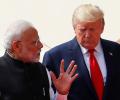
Delhi's appeasement strategy may now translate as more mega arms deals with the US, generating substantial business and job creation in the American economy. Make no mistake, Americans will use it to pressure India, predicts Ambassador M K Bhadrakumar.

The external environment has worsened further. While the Finnish economy entered into a recession, Swedish economic growth also dipped. The Finnish gross domestic product (GDP) dropped 0.6 per cent in October-December, 2022. It was the second quarter of negative growth, which is a technical definition of recession.

The new Samvat 2080 is viewed as a year of hope for industrial and precious metals. A key reason is the expectation of US interest rates peaking, followed by a reduction in the coming months. Regarding crude oil, its trajectory depends more on how the situation unfolds in West Asia.
The foreign inflows to the country will remain unchanged as the cut in the interest rates by US Federal Reserve is too minimal to affect the global investment scenario, analysts say.The US market went up after the rate cut was announced and some of the Asia markets also gained. Indian markets too opened higher on Thursday but Sensex plunged about 200 points due to profit booking, Kejriwal added.

The rupee depreciated by 37 paise to close at 79.62 against the US dollar on Thursday despite sustained foreign capital inflows and a positive trend in equities. At the interbank foreign exchange market, the local currency opened at 79.22 and saw an intra-day high of 79.22 and a low of 79.94 against the American currency. It finally ended at 79.62, down 37 paise over its previous close of 79.25.

A day after Federal Reserve Chairman Ben Bernanke announced the rate cut, FIIs bought shares worth over Rs 2,400 crore (Rs 24 billion), lifting the index up by 650 points, one of its biggest intra-day gains.
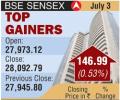
India's exposure to Greece being limited fuelled the rally.

Gains in realty, teck, IT, power, consumer durables, banking and oil & gas stocks helped both the key indices to score gains.

Equity benchmarks fell sharply on Thursday in line with an extremely weak trend in the global markets, with the Sensex plunging 1,154.78 points in early trade. Persistent foreign fund outflows and a spurt in crude oil prices also dampened sentiment. The 30-share BSE benchmark was trading 1,154.78 points lower at 53,053.75. The broader NSE Nifty tumbled 335.65 points to 15,904.65.

Indian equity markets had a good run in the first half of calendar year 2023 (CY23), with the S&P BSE Sensex and the National Stock Exchange Nifty50 hitting fresh 52-week highs. While the Sensex scaled up to a peak 64,718, the Nifty50 hit Mt 19,189. As the markets now prepare to enter the second half (H2) of CY23, all eyes are on global central banks, especially the US Federal Reserve, as to when they will pause and pivot as regards their interest-rate cycle.

With former prime minister Imran Khan in jail, Sharif's Pakistan Muslim League-Nawaz (PML-N) is tipped to emerge as the single largest party in the elections.
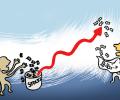
In a dazzling resurgence, foreign investors have graced the Indian equity markets with an influx of nearly Rs 1.5 lakh crore in 2023, fuelled by optimism over the country's resilient economic fundamentals amid shadows of a gloomy global scenario. Experts believe that the positive trend may continue in 2024. This follows Indian equities witnessing the worst-ever net outflow of Rs 1.21 lakh crore by FPIs in 2022 on aggressive rate hikes by the central banks globally after net inflows for three consecutive years.
Kerala-based Federal Bank on Monday said it was in race to acquire ailing Ganesh Bank of Kurundwad in Maharashtra and has submitted its expression of interest to the Reserve Bank of India.

'Historically, the markets tend to perform well during election years as governments aim to increase spending and call attention to growth.'
India, China and Russia have "squandered" capital by financing inefficient technologies, United States Federal Reserve Chairman Allan Greenspan has charged.

A piece of slightly negative news can cause a serious setback, warns Debashis Basu.

Benchmark indices continued their downtrend for the fifth session on the trot on Thursday, with the Sensex tumbling nearly 817 points in early trade, tracking weak global trends and selling in index majors Reliance Industries and HDFC Bank. Unabated selling by foreign institutional investors also weighed on the sentiment. The 30-share BSE Sensex was trading 816.78 points lower at 53,271.61. The NSE Nifty declined 234.05 points to 15,933.05.

Rajya Sabha witnessed heated exchanges between the treasury and opposition benches after Congress leader Mallikarjun Kharge made remarks on the manner in which political parties select women candidates from weaker sections and raised the issue of 'delayed' GST payments to non-Bharatiya Janata Party ruled states.

'Currently, 81 per cent of all reserved tickets are booked through e-ticketing.'
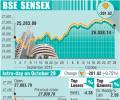
The Sensex closed 202 points lower to end at 26,838.

Index heavyweight RIL surged 3% to end above Rs 1,000 mark while IT majors were also the top gainers.

Within three trading sessions in May, foreign portfolio investors (FPIs) have pumped in Rs 9,461 crore into Indian equities. This follows net inflows worth Rs 7,936 crore in March, and Rs 11,631 crore in April. The trend, analysts said, could continue going ahead as the US Federal Reserve may soon halt its interest rate hike cycle, which will strengthen foreign fund inflows into emerging markets, including India.

Indices across Indian equity markets have edged towards new record highs before undergoing a small correction in the past few sessions. The National Stock Exchange Nifty has gained 20 per cent in the past year; mid-caps (up 33 per cent), small-caps (up 31 per cent), and micro-caps (up 44 per cent) have done better. Several factors have precipitated this rally.
